
Curious George: Telling the Story of Male Childhood Abuse through Children’s Books
Home >> Topics >> Books, Uncategorized
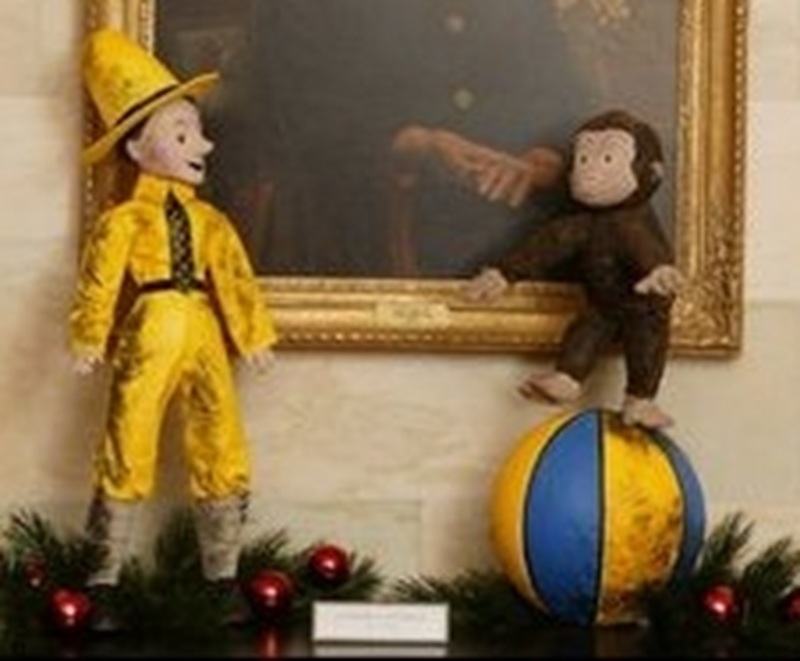
It’s been 84 years since “Curious George” began entertaining children and adults around the world. H. A. Rey gets the credit, but the nine original books were a collaboration with his wife, Margret. He did the drawings; she wrote the stories. Acquaintances in Hamburg, Germany, the two met again in Brazil, where they eventually married. Their honeymoon to Paris turned into a four-year relocation. Then World War II broke out.
The Nazis invaded France in May of 1940 and by June they occupied Paris. The Reys were Jewish. They knew they had to leave, and quickly, but there were no trains or cars running out of the city. Hans found a tandem bicycle for their escape. His wife, apparently, had the gall to request he make it into two bikes. He found the parts and obliged. They left with the manuscript of Fifi strapped to their backs. Fifi was George’s real name.
Fifi was not short for Josephine. George was and remains a male. It’s also not prison slang, though the etymological ties are strong. Since the 1900s, it’s been in use as a term for an effeminate man. By the 1940s it was slang for gay. American publishers convinced the Reys that George was a more masculine-sounding name.
The Reys did not have children. While in Brazil, they lived with two marmoset monkeys. The couple tried to bring them along on the voyage to France, but the sea crossing was long and cold. The monkeys didn’t make it. The original book was a memorial to their beloved pets.
What is it about George that makes him so endearing? The illustrations almost always depict him smiling. When he isn’t, things are not right at all. Of course, he’s so cute and effervescent. So much so that we tend to overlook what is arguably hiding in plain sight. This is a children’s tale, but the message is, if not outright bleak, at least grim. It reveals a world that is hard and cold, wrapped in an outward veneer of warmth and care.
The lifestyle circumstances of the Reys indicated they knew exactly the reality their art reflected. Middle-class, middle-of-the-road families would accept the book at face value, an adventure experienced vicariously through an anthropomorphized monkey. Children of the poor and the elite would receive confirmation that their brutal and empty reality was unchangeable and inescapable. Today’s grown man will certainly find his story, or parts of it, told through the pages of “Curious George.”
God works through people, even if they are unaware or unwelcoming of His presence. The Reys could have worked two messages simultaneously. To children growing up in safe, nurturing families, they seem to warn about being too curious. What you don’t know about might be far more harmful than you can fathom. To children living through nightmares, they seem to be saying Hey, bad things might happen. It might not even turn out well. But how you respond bears heavily on your own welfare and can either uplift or discourage others.
Some of us who read “Curious George” as children will be shocked to perceive the work through an alternative perspective. Those of you who recognized the horrors all along will wonder what took society so long to see how the world actually works. To you, we can only say, We are so sorry.
We first meet George swinging in the vine of a tree, eating an enormous banana. The flowers are smiling. A bright red butterfly flutters below. There’s a lizard on the tree, indicating that all this beauty is mixed with a warning of small transgressions potentially growing into dragons. The sexual implications are obvious, but George is a content little monkey, unaware of the consequences of being too carnally curious.
Enter a tall thin man dressed like an even bigger banana. His butt is sticking out and his rifle is slung ramrod straight up his back. He spies George from behind a tree. A tree can be symbolic of the cross, the possible implication being he’s hiding behind religiosity. “Wood” can also have an unholy implication, indicating the man is indistinguishable from the pursuit of worldly, bodily pleasures. The man sees George, has to have George, and goes about trapping him using his big yellow straw hat, which is shaped like a sombrero… Remembering that George is a boy, it seems painfully obvious where this is going.
George is attracted to the banana-like hat and puts it on his head, but it’s too big for him. In other words, he’s in over his head. The man steps in with an enormous foot, and we all know the subtext of big feet. He grabs him with two hands and “popped” George … into a bag. George’s expression is a mixture of shock and disbelief. This is his first introduction to man. He’s been kidnapped and, at the very least, manhandled.
The man with the big yellow hat is next seen sitting in a rowboat with his arm around the bagged George, with only his head visible. He’s restrained. They’re being rowed by a sailor. Alternate sexed people will see this as a male threesome. Hetero-sexed folks will recognize the reference to female genitalia, with the implication being that women are merely a means to get to the big ship, the one going places. Whether you end up in steerage or the Captain’s quarters is a result of socio-economic status.
By the way, the man’s hat is made of straw, which is repeated every time the man is mentioned. He could be representative of a strawman, a fallacy, a fake argument to distract. If George is a stand-in for a little boy, then at best the man is a kidnapper, at worst a child abuser. If George is a stand-in for a little boy, then at best the man is a kidnapper, at worst a child abuser. But he’s a strawman because the fight is not with him, but with the system that created him.
“George was sad, but he was still a little curious,” Margret writes. He’s looking away, dissociated from both the hunter man and the sailor man. He smiles at a couple fish swimming nearby. His only recourse is to segment off the trauma, and find simple moments of peace.
Aboard ship, in their cabin, the man with the big yellow hat sits on the lower bunk bed, and George sits across from him on a red-and-white striped stool. He’s been taken out of the bag. “…Things began to happen.” What “things”? Well, for one, George is told he’s going to live in a zoo. The man tells him this while pointing to his pipe. Essentially, telling George the man will take him places in life if he’ll satisfy his bodily needs.
A porthole portal has been opened. The camera slung on a wall hook is aimed at the man. For the blackmail system to work, everything must be photographed or filmed. So the man determines how George’s life is going to go, and George promises to be good. But he’s young, so he forgets. Children don’t have a say in what happens to them when they’re so young, vulnerable, and need care. Plus, they lack a frame of reference. It’s heartbreaking to hear that he’ll try to be good when he’s been traumatized and lacks the emotional development to express his righteous anger and sadness.
Left unattended on deck, George watches the seagulls and determines he can fly… overboard. In 1916, a study determined that of all the forms of maltreatment of a child, emotional abuse, physical abuse, neglect, and sexual abuse, only sexual abuse had a direct link to suicidal thoughts in the child. No stopoff at anxiety or depression. Suicide is the eighth leading cause of death in children ages 5 to 11. Wow. Just wow.
The sailors, two-thirds illustrated with their butts sticking out, call and look for George. He’s finally spotted on the other side of a porthole, and they throw him a lifebelt (British term). George is hauled out of the water upside down, a sailor pulling on each leg. He’s throwing up sea water and fish. One of the sailors is smoking a pipe.
No matter how you look at it, this is a disturbing scene. Drowning is the leading cause of death for children ages 1 to 4, and the second leading cause of death for ages 5 to 14, according to the Centers for Disease Control and Prevention.
“After that George was more careful to be a good monkey…”
And the heart breaks.
When the sea voyage is over, we see the status of the man with the big yellow straw hat. He’s rich. He carries one suitcase, while a man following him is loaded down with two more, plus a parcel, a duffle he balances on his head, and a bag of golf clubs. The captain of the ship salutes the man. Money outranks rank. The elite outrank the military. The dock workers, even if saved by the stripes they wear, are over a barrel and looking up to the money walking down the gang-way. Money buys immunity from treating other inhumanely.
George gets a taste of the good life: the best food and pipe. Read, food and sex. The correlation between those two needs and wants is age-old. They can either be wholesome and sustaining or debauched and addictive. The pajamas are too big for him. In other words, he’s a kid in an adult world when it comes to bedding. But it’s a comfortable bed, and all the bananas and man-goes he could want are laid out at his table.
One reason child abuse is rarely reported is due to the built-in system of rewards and benefits. For a child, bananas and mangoes, candy and nights at the rodeo; for an adult, a job, a promotion, a ticket to the big show of entertainment, business, or sports.
In the morning, George sees the man talking on the rotary-dial telephone. He wants to be like him. When the man leaves, George makes a call. Of course, being a monkey, he ends up dialing the fire department. He also knocks over the trash can. Bruised people can cause havoc, spilling the trash. The consequences are dire. The firemen figure out where the call came from and dispatch five vehicles to the scene. They find no fire. “ONLY a naughty little monkey.”
So, again, we have a situation where George has been left unattended. In an unintended call for help, let’s say, he only succeeds in bringing down more trouble. Firemen put out fires, literally and figuratively. Seven firefighters chase our little creature, who gets tangled in the telephone cord. Seven men on one monkey. Two firefighters, one thin with a smug expression, the other fat and berating George, each grab an upper arm of our friend. They haul him to prison. George’s expression is one of rage, humiliation, and hurt.
When we first see George in the bag, we detect his shock. Now, he’s angry and the sadness has been subplanted by helplessness and frustration. After this multiple-perpetrator assault, we see his innocence giving way to an awareness of how the world works. He’s arrested and thrown in prison. He is learning helplessness and that there is nobody he can trust.
In his cell, we see a depressed George. He’s joined by rats, who are enjoying his cheese. In 1940s slang, “cheese” was commonly used as cheese-it, a warning to knock off illegal activity because the law was closing in. This is also when “cheese” began to be used by photographers to capture a natural smile. It’s too late for George to either knock off the misbehavior that got him into trouble or to recapture his genuine smile. He never had a chance. Now he’s incarcerated.
He climbs up to the window ledge to see about the bars (obstacles to freedom). A watchman comes in, and in the course of trying to bring George down from the window, upends the bed and is trapped. An illicit use of a bed brings a body down, so to speak … literally. George capitalizes on the opportunity and escapes through the open door.
Does our friend pause and count his blessings or savor his newly found freedom? Certainly not. He’s curious, afterall, so he’s right back in the thick of things. He sees a ball-loon man and after a high-wire performance along the communication wires, he reaches out to help himself to a balloon. Monkeys don’t know about money, or theft, or self-control. Instead of one balloon, George ends up grabbing the whole bunch, which promptly carries him airborne. Airborne!
George is terrified. He’s holding on for dearest life as he looks down at the masses below. Metaphorically speaking, he looks down on people, but he’s being carried away by forces he can’t control. The wind blows him hard, then less so, and finally it dies out. He’s exhausted. And who is “the prince of the power of the air”?
After getting taken for a ride, George lands atop a traffic pole. No double-entendre explanation necessary. The man with the big yellow hat comes to his rescue, pays off the balloon man and whisks George off to the zoo, where he can’t be a menace to himself or anyone else anymore.
At the zoo, we see that George has distributed his balloons to the other animals in the zoo. He’s been gracious to the others trapped with him, bringing them a small token of childhood delight. He has a big smile on his face as he holds on to his one red balloon and sits in a tree. But unlike when he was a younger monkey, the tree he’s now sitting in has no greenery. It’s dead. He’s an exhibit in a zoo. He appears to have it all, and to be enjoying his life as a showman, surrounded by adoring fans.
George never had a chance. He wasn’t brought up to be wise about the ways of the world, or the one path to a simple, contented life of goodness.